A VQE that warms up — and checks its own work
Variational quantum eigensolvers (VQE) are one of the more practical things you can run on a near-term quantum computer. The recipe: parameterise a quantum circuit, measure the energy of its output state for some Hamiltonian H, and let a classical optimiser tweak the parameters until the energy is as low as it goes — that minimum is supposed to be the ground state of H.
The catch: it usually isn't.
Why cold VQE is hard
Two things tend to break the recipe:
- Barren plateaus. Initialise your circuit's parameters at random and, for most reasonable problems, the loss landscape is essentially flat in every direction. Imagine looking for a buried coin on a featureless parking lot with a metal detector — it buzzes the same everywhere. Gradient descent doesn't know where to step.
- Local minima. Even when you do have a usable gradient, it might walk you into a shallow valley that isn't the deepest one. You converge, you report a number, and the number is wrong.
Easing into the answer
Our paper proposes a fix that's almost embarrassingly intuitive: don't start cold. Start with a problem you know how to solve and slowly morph it into the one you actually care about.
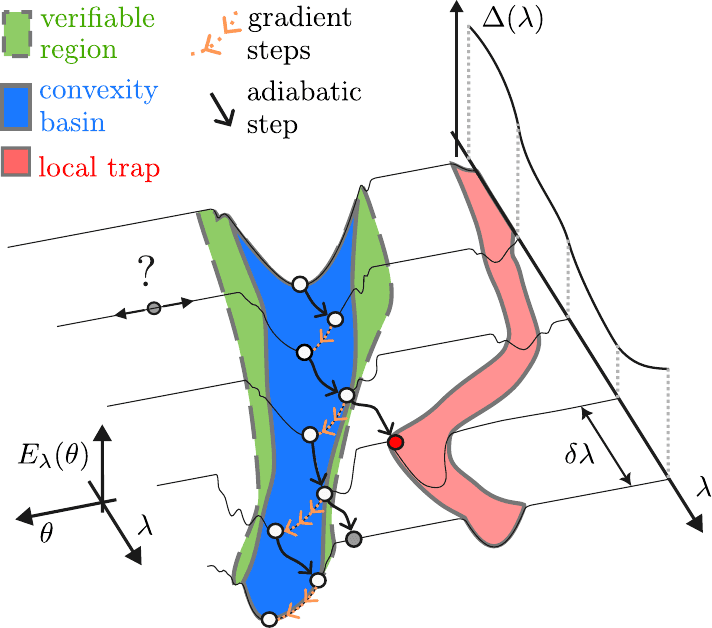
Concretely: pick a simple Hamiltonian whose ground state your circuit can trivially prepare (the easy end of the path). Then interpolate towards your target along a sequence . At each step you run VQE — but warm-started from the previous step's parameters.
Nobody plunges straight into a hot tub. You ease in. Same idea — the adiabatic path is the temperature dial.
The picture above is the whole paper in one panel. Each black arrow is an adiabatic step — a small move along the path . The orange dotted arrows are the gradient steps that solve VQE locally at each . As long as you stay inside the blue convexity basin, gradient descent provably reaches the bottom; the surrounding green verifiable region is where the energy variance can certify you're really on the ground-state branch. The red blob on the right is a local trap — exactly the kind of valley that cold-started VQE falls into. The little grey dot off to the side is a random initialisation with nothing to guide it.
Why it actually works
The interesting part isn't the recipe — it's that we can pin down when the recipe is guaranteed to work. The paper derives conditions on the path and the circuit ansatz under which gradient-based optimisation provably keeps tracking the true ground state all the way along. When those conditions hold:
- No barren plateaus. Each step starts from a sensible point (the previous step's solution), not from random noise.
- No wrong valleys. The adiabatic path is a guide rail — you can't fall into a stray local minimum if the route only ever bends gently.
A VQE that checks its own homework
The other half of the paper: you don't have to trust that you've converged. You can measure it.
The trick is the energy variance, . For any eigenstate of this is exactly zero, and for anything else it's strictly positive. So at runtime you measure it, and:
- variance ≈ 0 → you really are in an eigenstate
- variance large → you're not, keep optimising
Combined with knowing your warm start kept you on the ground-state branch all along, the variance acts as a self-checking flag — the algorithm certifies its own answer without needing the correct one in advance. A bit like a Sudoku that lights up when every row, column and box check out.
Read the paper
arxiv:2602.17612 — Scalable, self-verifying variational quantum eigensolver using adiabatic warm starts, with Marco Ballarin, Lewis Wright and Michael Lubasch.